
Please wait while we process your order...

Product successfully added to your cart.
Placeholder Image

Quantity in Cart: 1


Continue Shopping Shopping Cart
Item removed from Cart
X
 
×

PowrCoat 745 Bleed Valve Assembly Parts

PowrCoat 745 Bleed Valve Assembly Parts

PowrCoat Pressure-Relief and Return-Flow Components · Assembly 944-028A

Restore Reliable PowrCoat 745 Bleed-Valve Operation

Shop verified components for the PowrCoat 745 Bleed Valve Assembly, including the operating knob, valve housing, PTFE O-ring, stem stop, tungsten ball, copper gasket, and tungsten valve seat. Match the numbered diagram position and exact Titan part number before ordering.

01
Official Seven-Part Diagram
Every retained component matches Titan’s PowrCoat bleed-valve table.
02
Pressure-Relief Function
Supports priming, flushing, cleanup, and controlled system depressurization.
03
Ball-and-Seat Diagnosis
Inspect both tungsten sealing surfaces before replacing either part.
04
Verified Product Links
Each replacement card points to the live item shown on the supplied page.
Assembly Overview

How the PowrCoat 745 Bleed Valve Controls Return Flow

This page is an exploded replacement-parts category for complete bleed-valve assembly 944-028A on PowrCoat 745 cart model 0533745C and wall model 0533745W. Titan documents the same internal parts on PowrCoat 730, 940, 960, and 975.

Turning the knob counterclockwise opens the return path so air, solvent, or coating can move through the bleed hose. Turning it clockwise seats the tungsten ball against the valve seat and redirects pressurized coating toward the hose and spray gun.

Main Functions

Functions Supported by the Bleed Valve Assembly

  • Opens a controlled return path during priming.
  • Routes flushing solvent and coating through the bleed hose.
  • Supports safe pressure relief before service.
  • Closes the return circuit for normal high-pressure spraying.
  • Provides a replaceable tungsten ball-and-seat sealing interface.
Service Applications

When Technicians Use This Bleed-Valve Diagram

  • Coating continues flowing from the return hose after closure.
  • The valve will not open, close, or turn smoothly.
  • External leakage appears around the housing or stem.
  • Priming or flushing flow becomes restricted.
  • Pressure cannot be relieved predictably before maintenance.
Troubleshooting

PowrCoat 745 Bleed-Valve Symptoms and Inspection Priorities

Diagnose the valve, bleed hose, filter body, fluid pump, coating condition, and threaded connections before replacing parts. Relieve all pressure before disassembly.

Operating symptom Inspection points Recommended action
Material flows from bleed hose when valve is closed 944-024 knob travel, 944-026 stop, 761-715 ball, 944-904 seat, contamination, and housing alignment Confirm full closure, then inspect and clean the ball and seat together before replacement.
Valve is difficult to turn 944-024 knob, stem, 944-026 stop, 944-004 O-ring, dried coating, housing threads, and overtightening Relieve pressure and isolate binding before replacing the knob, stop, or seal.
External leak around valve housing 944-020 housing, 944-004 PTFE O-ring, 945-003 gasket, seat threads, cracks, corrosion, and filter-port connection Locate the exact interface and inspect mating surfaces before replacing the seal, gasket, housing, or seat.
No flow through bleed hose during priming knob opening travel, valve stop, ball release, seat passage, housing passage, bleed hose, return fitting, and coating blockage Clear the hose and passages and verify ball movement before replacing valve components.
Pump cycles slowly with gun closed partially open bleed valve, worn ball and seat, lower pump packings, loose fluid connections, and check balls Confirm whether coating exits the bleed hose before diagnosing the pump or replacing valve parts.
Pressure does not relieve predictably valve opening, bleed-hose restriction, knob and stop movement, seat passage, gun trigger, and trapped hose pressure Stop operation and verify the full Titan pressure-relief sequence before servicing the valve.
Verified Replacement Components

High-Value PowrCoat 745 Bleed-Valve Parts

Only components listed on the supplied page and confirmed in Titan’s official seven-position diagram are included.

Manual Valve Control

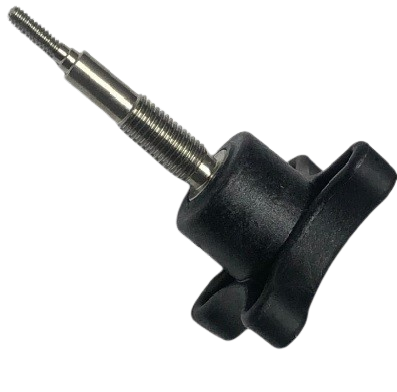
Titan 944-024 Knob

Attaches to the valve stem so operators can open the bleed path for priming, flushing, pressure relief, and cleanup.

View Titan 944-024
Valve Body

Titan 944-020 Valve Housing

Forms the structural body, fluid passage, threaded interfaces, and alignment surfaces for the internal bleed-valve components.

View Titan 944-020
Chemical-Resistant Seal

Titan 944-004 PTFE O-Ring

Seals the internal stem-and-stop area and helps prevent fluid leakage through the operating section of the valve.

View Titan 944-004
Stem Travel Control

Titan 944-026 Valve Stem Stop

Limits and positions valve-stem movement so the ball can lift from and return to the seat predictably.

View Titan 944-026
Tungsten-Carbide Check Ball

Titan 761-715 Tungsten Ball

The documented quarter-inch ball closes against the valve seat to stop return flow during normal spraying.

View Titan 761-715
Seat Interface Gasket

Titan 945-003 Copper Gasket

Provides the documented sealing interface between the valve housing and tungsten valve-seat component.

View Titan 945-003
High-Wear Valve Seat

Titan 944-904 Tungsten Valve Seat

Provides the hard sealing surface for the 761-715 ball and controls shutoff between spray and bleed operation.

View Titan 944-904
Buying Guide

How to Select the Correct Bleed-Valve Component

STEP 1

Confirm assembly 944-028A

Use the PowrCoat 745 bleed-valve diagram and exact numbered position.

STEP 2

Identify internal or external leakage

Separate ball-and-seat bypass from O-ring, gasket, housing, or thread leakage.

STEP 3

Inspect mating parts together

Check ball with seat, gasket with seat, and O-ring with housing surfaces.

STEP 4

Verify safe manual operation

Confirm knob and stem-stop travel before placing the sprayer back in service.

Maintenance

Maintenance Practices for Dependable Bleed-Valve Operation

  • Flush the return passage before coating dries inside the valve.
  • Exercise the knob through full open and closed positions.
  • Inspect the ball and seat whenever closed-valve bypass appears.
  • Check the O-ring, copper gasket, housing, and threads for leakage.
  • Keep the bleed hose clear, secured, and routed into a grounded container.
  • Never loosen valve components while the system is pressurized.
Repair Planning

Plan a Complete PowrCoat 745 Bleed-Valve Repair

For failure to open or close, inspect the knob, stem movement, valve stop, PTFE O-ring, dried coating, and housing alignment. For bypass leakage, inspect the tungsten ball and tungsten seat as a matched sealing interface.

For external leakage, inspect the valve housing, O-ring, copper gasket, seat threads, filter-body port, return hose, and fitting before deciding whether individual components or complete assembly 944-028A is required.

Fast Navigation

Shop Major PowrCoat 745 Bleed-Valve Components

FAQ Section

PowrCoat 745 Bleed Valve Assembly FAQs

Verified answers covering assembly identification, model fitment, operation, leakage diagnosis, priming, pressure relief, and repair planning.

What type of page is the PowrCoat 745 bleed-valve page?+
It is an exploded replacement-parts category for complete bleed-valve assembly 944-028A and its seven internal components.
Which PowrCoat models use these bleed-valve parts?+
Titan lists the same seven parts for PowrCoat 730, 745, 940, 960, and 975.
Which PowrCoat 745 models are covered?+
Titan identifies PowrCoat 745 cart model 0533745C and wall model 0533745W.
What does the bleed valve do?+
Opening the valve routes coating through the bleed hose for priming, flushing, and pressure relief. Closing it directs pressurized coating toward the spray hose and gun.
Which direction opens the bleed valve?+
Titan instructs operators to turn the bleed valve fully counterclockwise to open it and fully clockwise to close it.
Why can coating continue flowing from the bleed hose?+
The valve may be partly open, the 761-715 ball may be contaminated or worn, the 944-904 seat may be damaged, or internal sealing components may not be seating correctly.
What should be checked when the knob turns but the valve does not operate correctly?+
Inspect the 944-024 knob connection, valve stem, 944-026 stop, housing threads, and internal ball-and-seat movement before replacing a component.
Why should the ball and seat be inspected together?+
The 761-715 ball seals directly against the 944-904 seat. Replacing only one may not stop leakage if the mating surface is damaged.
What can cause external leakage at the valve body?+
Inspect the 944-020 housing, 944-004 PTFE O-ring, 945-003 copper gasket, threaded joints, cracks, corrosion, and assembly alignment.
When should the complete 944-028A assembly be considered?+
Consider the complete assembly when multiple hard parts are damaged, the housing threads are unusable, or reliable sealing cannot be restored after confirmed component diagnosis.
Why is the bleed valve important during priming?+
The open return path allows air and coating to circulate through the pump and bleed hose until material flows consistently.
What safety procedure is required before service?+
Lock the gun, close the air shutoff valve, open the bleed valve, ground and trigger the gun into a metal container, then verify zero stored pressure.
Find the Correct Replacement Part

Restore Controlled Priming, Pressure Relief and Closed-Valve Sealing

Browse verified PowrCoat 745 bleed-valve control, housing, sealing, ball, gasket, stop, and seat components.

Search using:
  • Titan part number
  • 944-028A diagram position
  • Knob, housing, seal, ball, or seat
  • Priming or pressure-relief function
  • Bypass, external leak, binding, or blockage symptom

Related PowrCoat 745 Bleed-Valve Searches