


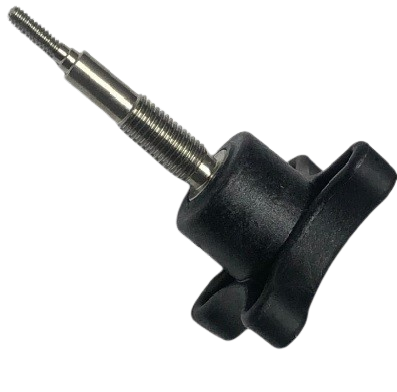

PowrCoat High-Pressure Return-Flow Control · Complete Assembly 944-028A
Restore Reliable Priming and Pressure Relief with Verified Valve Parts
Shop confirmed components for the PowrCoat 940 Bleed Valve Assembly, including the operating knob, precision housing, PTFE stem seal, valve stop, tungsten ball, copper gasket and tungsten seat. Titan’s official seven-position diagram applies to PowrCoat 730, 745, 940, 960 and 975.
How the PowrCoat 940 Bleed Valve Controls Fluid Direction
This page is an exploded bleed-valve replacement-parts category for complete assembly 944-028A on PowrCoat 940 cart model 0533940C and wall model 0533940W. Titan documents the same seven internal positions for PowrCoat 730, 745, 940, 960 and 975.
Turning the knob opens or closes the return-flow path. In the closed position, ball 761-715 seals against seat 944-904 so coating moves toward the spray hose. Opening the valve allows material and trapped air to return through the bleed circuit during priming, flushing and pressure relief.
Functions Supported by the Bleed Valve Assembly
- Opens the return path during priming and flushing.
- Provides controlled fluid-pressure relief before service.
- Closes the return path during normal spray operation.
- Seals high-pressure coating with a tungsten ball and seat.
- Connects directly to the high-pressure filter assembly.
When Technicians Use This Valve Diagram
- Material continues flowing through the return hose.
- The valve will not open for priming or pressure relief.
- Coating leaks around the stem or threaded seat.
- The knob turns without controlling fluid direction.
- Hard parts show wear, corrosion or thread damage.
PowrCoat 940 Bleed-Valve Symptoms and Inspection Priorities
Relieve all pneumatic and fluid pressure before service. Diagnose contamination, control travel, sealing surfaces and threaded interfaces before replacing components.
High-Value PowrCoat 940 Bleed-Valve Parts
Only genuine products shown on the supplied page, confirmed in Titan’s diagram and matched to live product URLs are included.
Titan 944-024 Knob
Official position-1 control used to open and close the bleed valve during priming, flushing and pressure-relief procedures.
Titan 944-020 Valve Housing
Official position-2 housing that aligns the stem, seal, stop, ball, gasket and seat while containing the return-flow passage.
Titan 944-004 PTFE O-Ring
Official position-3 PTFE O-ring that seals the moving valve interface and helps prevent coating leakage around the stem.
Titan 944-026 Valve Stem Stop
Official position-4 stop that controls stem travel and maintains the intended relationship between the knob, ball and seat.
Titan 761-715 Tungsten Ball, 1/4"
Official position-5 ball that closes against the valve seat to stop return flow during spraying.
Titan 945-003 Copper Gasket
Official position-6 gasket that seals the joint between the valve housing and threaded valve-seat component.
Titan 944-904 Tungsten Valve Seat
Official position-7 seat that provides the sealing surface for the 761-715 ball and threads into the connected filter assembly.
How to Select the Correct Bleed-Valve Component
Confirm assembly 944-028A
Use this diagram for the PowrCoat 730, 745, 940, 960 and 975 bleed valve.
Identify the leak location
Separate return-path bypass, stem leakage and threaded-seat leakage.
Inspect the control train
Check the knob, stop and stem travel before ordering hard parts.
Evaluate the complete sealing stack
Inspect ball, seat, gasket, O-ring, housing and contamination together.
Maintain Reliable Priming and Pressure-Relief Control
- Flush the bleed circuit before coating dries in the valve.
- Operate the knob only after following the proper pressure procedure.
- Inspect return flow to confirm complete valve closure.
- Check the stem area and seat joint for visible leakage.
- Protect the tungsten ball and seat from contamination.
- Never disassemble the valve while fluid pressure remains.
Plan a Complete PowrCoat 940 Bleed-Valve Repair
Record whether the fault is continuous return flow, external stem leakage, seat-joint leakage or restricted operation. Each symptom points to a different area of the seven-part assembly.
During teardown, inspect the knob engagement, stop, PTFE O-ring, housing bore and threads, tungsten ball, copper gasket and tungsten seat. Choose the complete 944-028A assembly only after determining that several hard parts are damaged or individual repair is uneconomical.
Shop Major PowrCoat 940 Bleed-Valve Components
PowrCoat 940 Bleed Valve Assembly FAQs
Verified answers covering valve function, model compatibility, pressure relief, leakage diagnosis, control problems, repair scope and safe service.
Restore Priming, Return-Flow Control and Dependable Pressure Relief
Browse verified PowrCoat 940 knob, housing, seal, stop, tungsten ball, gasket and valve-seat components.
- Titan part number
- Bleed-valve diagram callout
- Complete assembly 944-028A
- Knob, housing, seal, ball or seat
- Return-flow, leakage or pressure-relief symptom