
Most bad airless spray patterns come from five causes: a partly clogged tip, pressure that is too low or too high, a tip that is too large for the sprayer, a worn tip, or coating that is too thick. Check the tip and filters first. Pump packings, balls and seats come last.
Read the pattern first
Titan's own troubleshooting article names five causes of a bad spray pattern. The pattern itself tells you which to suspect: tails (heavy edges with a thin middle), streaks, striping and uneven color distribution each point somewhere different. Spray a test pass on a scrap board or cardboard, hold the gun square and keep the distance steady, so that technique does not get blamed on the equipment.
Pattern symptom, likely cause and the first check
| What you see | Likely cause | First check |
|---|---|---|
| Streaks or a split pattern | Partly clogged tip | Clean the tip or turn a reversible tip 180 degrees |
| Tails at the edges | Pressure too low | Pressure setting, then tip size against the sprayer |
| Heavy overspray and wasted paint | Pressure too high or a worn tip | Lower the setting; inspect the tip |
| Spitting or pulsing | Blocked filter, air in the system | Gun, pump and inlet filters |
| Pressure that will not stay steady | Pump packings | Wet cup for leaks, then the repacking kit |
| Pump reaches one side of the stroke then returns fast | Worn ball and seat | The fluid section diagram for your model |
The symptoms and causes follow Titan's five causes of a bad spray pattern. Your model's manual covers the pump work.
Cause 1: a partly clogged tip
A tip that is only partly blocked still sprays, but the pattern breaks up into streaks. Clean it with the solvent the coating maker recommends, or replace the tip. Reversible tips such as the TR1 and SC-6+ turn 180 degrees to clear a clog, as the tip's instructions describe. Do this after pressure relief, never with the trigger squeezed against your hand.
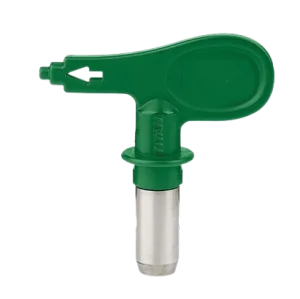
If the pattern clears after a rotation and then breaks up again, the tip is probably wearing as well as clogging. A 330-517A TR1 517 High Efficiency Airless Tip is one reversible replacement, and the 671-310 SC-6+ 310 Fine Finish Tip is a fine finish option. The full range is on the Airless Spray Tips page. Check that the tip suits your sprayer before you buy.
Cause 2: pressure that is too low, too high or unstable
Too little pressure gives tails. Too much gives overspray, wasted coating and extra cleanup. Adjust the pressure setting until the tails go and stop there. If the sprayer is already at its maximum pressure and still leaves tails, Titan's advice is to use a larger-diameter hose or shorten the hose, because friction in a long run takes pressure away before the tip.
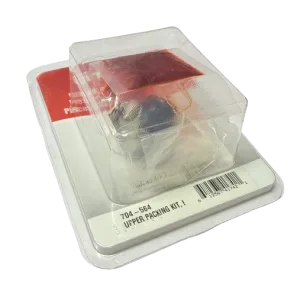
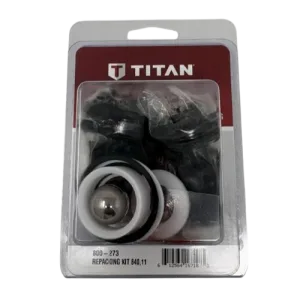
Pressure that is unsteady is a different problem. If the sprayer will not hold a steady pressure, check the pump packings. If the pump gets to one side of the stroke and then rapidly returns, Titan points to a worn ball and seat. That is the pump's inlet or outlet valve, and it shows up as the pulsing and loss of pressure. The Repacking Kits page lists kits such as 704-564 and 800-273, and the fitment text on each part page tells you which sprayers it lists. A scored piston rod destroys new packings, so inspect the rod when the pump is open.
Causes 3 and 4: a tip that is too large or too worn
A tip too large for the sprayer's rating makes the sprayer unable to build pressure, and you get the same tails as a low pressure setting. Tip numbers are three digits: the last two are the orifice in thousandths of an inch, so a 517 has a 0.017 in. orifice, and the first digit doubled is roughly the fan width in inches. Check your sprayer's maximum tip size in its manual before you move up a size.
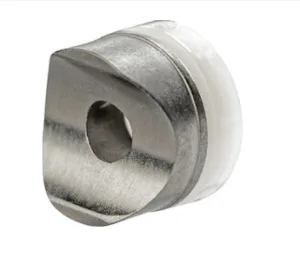
A worn tip does the opposite: the orifice has grown, flow rises, the fan narrows and you see overspray and waste. Replace it. When the tip comes off, check the seals, because a leaking seal sends paint where it should not go. The 661-020 Tip Seat and Seal Kit (5 Pack) is on the Titan Seals page, and a damaged or loose tip guard from the Tip Guards page should be replaced at the same time.
Cause 5: coating and filters
A coating that is too thick will not atomize cleanly. Thin only as the coating manufacturer allows, and add the solvent that the coating maker names. Strain and stir the coating before it goes into the sprayer.
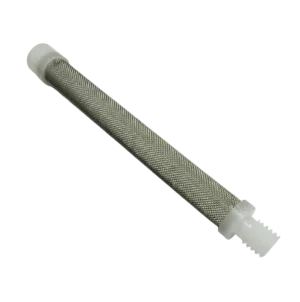
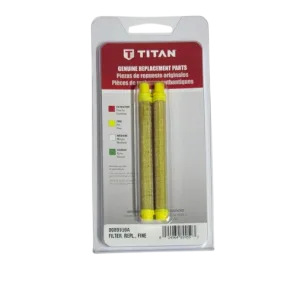
Filters sit between the pump and the tip, and a blocked one causes pressure loss, pulsing and spitting. Clean the gun filter, pump filter and inlet strainer after every job. If one will not clean, replace it with the same mesh. Two mesh sizes on the Titan Filters page are 540-060 (60 mesh, white) and 0089959 (100 mesh, yellow). Match the mesh to the coating and your manual.
Lowest-cost check first, then the pump parts
Relieve pressure, then clean or turn the tip
It costs nothing and clears the most common cause.
Inspect the tip and filters
Replace a worn tip. Clean or replace blocked filters, and check the coating is strained and thinned as its maker allows.
Check the pressure setting and hose
Adjust the setting for tails or overspray. If you are at maximum pressure, look at hose diameter and length.
Then the pump: packings, rod, balls and seats
If pressure still will not hold steady, look at the wet cup, the piston rod and the inlet and outlet valves, using your model's manual for the procedure.
Call with your model and serial number
(713) 931-0006. We will help you match the repacking kit or valve parts before you order.
Parts mentioned in this guide, with live pricing:

The Short Version
Read the pattern, then work in order: tip, filters, pressure setting, and only then the pump. Most pattern problems are cleared by a clean or replaced tip. When pressure itself will not hold steady, the packings, rod, balls and seats are the parts to look at.
Not sure which part is causing the pattern?
Call (713) 931-0006 with your model and serial number and what the pattern looks like.
(713) 931-0006Order by Parts Diagram