
A piston pump moves paint with a rod that strokes up and down through packings, while an inlet valve and an outlet valve (a ball on a seat) force the paint one way. The packings, balls, seats and the rod are the wear parts. Leaks at the wet cup, pulsing, and failure to prime or hold pressure usually trace back to one of them.
What the pump actually does
An airless sprayer does not use air to break up paint. It forces the coating through a small tip orifice at very high fluid pressure, and the pump is what builds that pressure. In a piston pump, a rod moves up and down inside a cylinder. On one stroke it draws paint in through the inlet valve; on the other it pushes paint out through the outlet valve toward the hose and gun.
Two things make that work. The first is the seal around the rod: packings, held in place by springs, retainers and glands, keep paint from escaping along the rod and keep pressure from leaking back. The second is the pair of one-way valves. Each is a ball resting on a seat. Pressure lifts the ball to let paint through and pushes it back onto the seat to block the return.
That is the whole mechanism, and it is why almost every piston-pump problem comes down to one of four things: a worn packing, a ball that no longer seats, a damaged seat, or a rod that has lost its smooth surface.
The parts that wear, and what each one does
Piston pump wear parts
The part numbers above are examples from the site's diagrams. They are not interchangeable across every sprayer, so always take the number from the diagram for your model.
Symptom to part
What the pump is telling you
| Symptom | Likely cause | Check first |
|---|---|---|
| Paint around the wet cup | Worn packings | Packings and the condition of the rod |
| Pressure will not hold, or the pump will not prime | Inlet or outlet ball not seating | Debris in the foot valve seat; ball and seat wear |
| Pulsing or spitting | Worn valve, partly blocked filter, or air in the system | Clean the filters, then inspect valves |
| Pump moves fast | Empty container or a stuck bottom ball | Paint supply and the foot valve |
| Pump delivers on one stroke only | Upstroke only: lower ball not seating. Downstroke only: upper ball not seating or worn packing | Clean and inspect the seats |
| Pump chatters | Upper packing swollen by solvent | Replace the packing set per the manual |
Stroke-direction and chatter symptoms come from Titan's Hydra manuals; the other rows are general airless guidance. Follow the manual for your model.
Which Titan sprayers use a piston pump
- Hydraulic piston sprayers: Hydra, PowrTwin, PowrBeast and PowrTex. Titan's category here means an engine or electric motor drives a hydraulic pump, and a hydraulic motor strokes the piston-type fluid pump.
- Epic: an older electric and gas series. Titan describes the fluid section as giving access to the inlet and outlet valves and seats without taking the unit completely apart.
- Advantage and EPX: Titan describes a sleeveless fluid section with stationary packings. The site lists a piston rod, a repacking kit and valve balls and seats for them.
- ControlMax: the cart-model diagram lists a piston/seal assembly, inlet and outlet valve parts and a fluid section assembly.
- ProMark II line striper: its fluid section diagram shows an upper piston guide, a piston rod, an inlet valve ball and a foot valve seat.
Two sprayers that look similar on a quote do not use this design. The ED655 and ED655 Plus are airless diaphragm pumps with a diaphragm, pump head and inlet and outlet valves but no rod packings. The PowrMax 605 is a rotor-stator sprayer for texture and aggregate. Do not apply packing advice to either one.
Find your pump on the site
Packings, foot valve and balls on the M2000 pump.
Upper packing, lower seal, valve parts.
Piston rod, valve balls and seats, repacking kit.
Repacking kit, packing springs, valve parts.
Piston rod, inlet ball, foot valve seat.
Those pages are examples, not the full list. If your sprayer is not shown, browse by model from the parts diagram menu or call (713) 931-0006 with the model and serial number.
Taking care of the pump
- Flush the sprayer after every use so paint never dries in the pump, hose or gun.
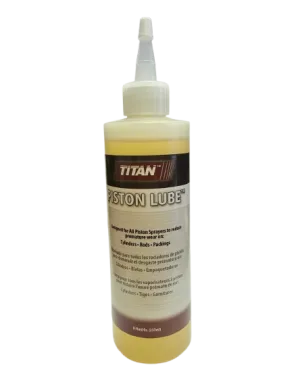
- Keep the wet cup topped up with the fluid your manual specifies. Piston Lube 314-480 is the one Titan names for several of its models.
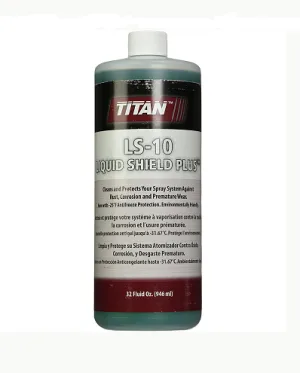
- For short-term latex storage, Titan's manuals call for water mixed with Liquid Shield 314-482 pumped through the system.
- Do not run the pump dry. The Advantage 400 manual warns that doing so wears the packings.
- Replace a scored rod before fitting new packings, or the new ones will not last.
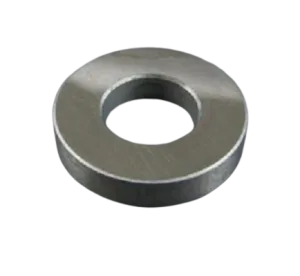
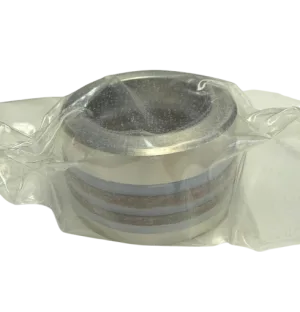
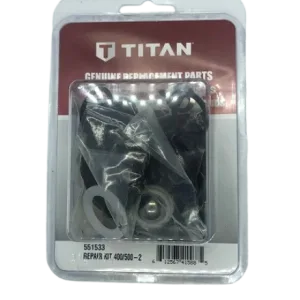
Wear parts and care products from the diagrams discussed above.



The short version
A piston pump is a rod, its packings and two ball-and-seat valves. When it leaks, loses pressure or will not prime, the cause is nearly always one of those. Check filters and paint supply first, then open the diagram for your sprayer and order by callout. Call (713) 931-0006 if the model is uncertain.
Need a pump part for your sprayer?
Open the fluid section diagram for your model, or call (713) 931-0006 with the model and serial number.
(713) 931-0006Order by Parts Diagram