
An airless paint sprayer has a drive (motor, gear box or engine) that moves a pump, a fluid section with packings and valves that pressurises the paint, filters at the inlet, pump and gun, a pressure control, a hose and a gun with a tip. The packings, valve balls and seats, filters and tip wear first. This guide covers paint sprayers, not agricultural or garden sprayers.
How an airless sprayer works in one paragraph
A pressurised pump forces the coating through a small orifice in the tip, and no compressor is involved. The drive turns a motor or engine into pump strokes, the pump builds pressure, and the hose carries the coating to the gun. That pressure is also why safety matters: an airless jet can inject paint through the skin.
Drive: motor, gear box, hydraulic or air motor
The drive supplies the motion. What it looks like depends on the sprayer class:
- Electric piston sprayers use an electric motor and a gear box. The site's diagrams call these pages Drive Assembly, Gear Box or Motor Assembly. Browse them from the electric airless sprayer parts hub.
- Hydraulic sprayers use a hydraulic system. On the Hydra series Titan specifies its Coolflo hydraulic fluid, and the engine is a gas engine. The gas airless sprayer parts hub lists those models.
- Pneumatic sprayers use an air-powered ratio pump instead of a motor. The air powered airless sprayer parts hub covers them.
You rarely replace a whole drive. The parts that fail first are small ones: a worn gear, a motor brush, a switch or a control knob. Find the exploded drawing for your model and look up the failed part by its callout.
Pump: fluid section, packings, piston rod, valves
The fluid section is where the paint is pressurised, and it is where most wear happens. In a piston pump the piston rod moves through packings that seal it. The wet cup holds pump armor or throat-seal lubricant that keeps those packings lubricated. Inlet and outlet valves, each with a ball and a seat, open and close on each stroke.
Fluid section wear signs
| Part | What it does | Sign it is worn |
|---|---|---|
| Packings | Seal the piston rod | Leaking at the wet cup, paint in the wet cup, or pressure that will not hold |
| Piston rod | Moves through the packings | Scored surface, which destroys new packings |
| Inlet and outlet valve balls and seats | Control the direction of flow | Pulsing, loss of pressure or failure to prime |
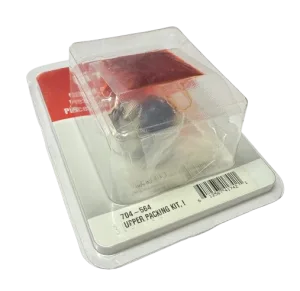
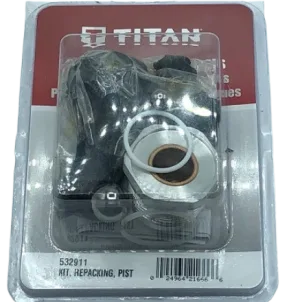
The piston rod must be smooth, so inspect it whenever you replace the packings. The site groups the repair parts in two places. Titan Repacking Kits and Pump Service Kits lists kits such as 704-564, an upper packing kit, and 0532911, a fluid section repacking kit. Titan Piston Rods and Piston Assemblies lists rods such as 704-551A. Kits are model-specific, so match the number to your model's diagram.
Filters: inlet strainer, pump filter, gun filter
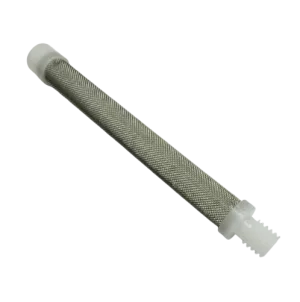
Airless systems usually have three filter points: a suction or inlet strainer, a pump or manifold filter and a gun filter. A partly blocked filter causes pressure loss, pulsing and spitting, so clean them after every job and use a mesh suited to the coating.
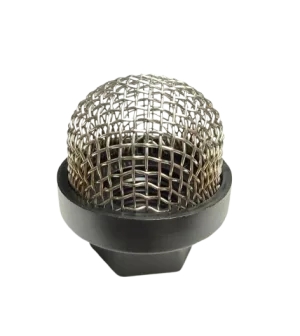
The Titan Filters page lists them by mesh, for example 540-060 (60 mesh), 0089959 (100 mesh, yellow) and 540-150 (150 mesh, red). The 700-805 inlet screen filter is an example of the strainer that sits on the suction side.
Pressure control, hose and gun
Pressure is set by a pressure control, a knob on some sprayers and an electronic control on others. A pressure that is too high gives overspray and waste, and one that is too low gives streaks and tails.
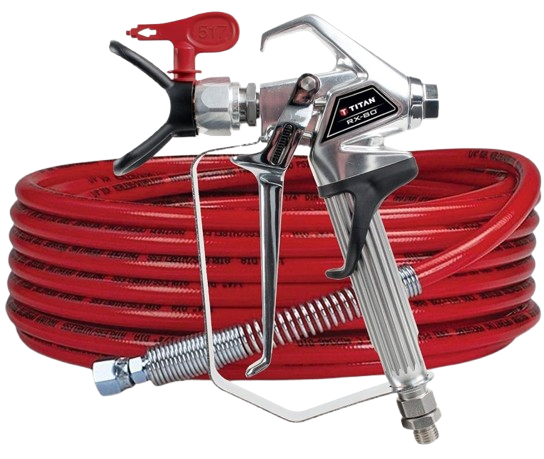
The hose is conductive and pressure-rated. Replace a damaged hose rather than repairing it, and make sure every component, hose, gun, tip guard and fitting, is rated at or above the lowest working-pressure rating in the system. The Titan Hoses page lists the options.
The gun holds the trigger lock, the gun filter and the tip. Titan's RX-80, RX-Pro and RX-Apex are three gun lines, and the 2454979 RX-80 is one of the guns listed on the guns, hoses and tip kits page. The tip decides the fan width and how much material is delivered, and a worn tip has a wider orifice, so the pattern turns coarse. The 0289228 tip guard fits over the tip and helps keep a hand away from the jet.
Frame, cart and accessories
The rest of the sprayer is the frame or cart, the siphon or suction set that draws paint from the pail, and accessories such as extensions and swivels. Most diagram sets have a cart or frame page, a suction set page and an accessories page. A broken wheel or a cracked siphon tube is quick to identify once you open the right page.
Where each component sits on the site
| Component | Where to look |
|---|---|
| Drive, gear box, motor | Your model's Drive, Gear Box or Motor Assembly page, through the series hub |
| Fluid section, packings, valves | Your model's Fluid Section page, plus Repacking Kits and Piston Rods |
| Filters | Titan Filters page and your model's filter or manifold page |
| Hose | Titan Hoses page |
| Gun, tip, tip guard | Guns, Hoses and Tip Kits, Titan Seals and Tip Guards pages |
| Cart, frame, siphon | Your model's Cart, Frame and Suction Set pages |
Examples of parts from each group:


The Short Version
A sprayer is a drive, a pump, filters, a hose and a gun. The packings, valves, filters and tip wear first, and a model's own diagram tells you which number to order. Relieve pressure with your manual's procedure before you touch any of it.
Not sure which diagram holds your part?
Call (713) 931-0006 with your model and serial number and our parts team will confirm the part before you order.
(713) 931-0006Order by Parts Diagram