
A PowrCoat runs compressed air through an air motor, and the motor strokes a piston pump that pushes coating toward the gun at high pressure. The ratio is the multiplier: air pressure at the motor times the ratio gives fluid pressure, so a 40:1 PowrCoat on 100 psi of air reaches 4000 psi. AirCare conditions the air, and a filter and bleed valve sit after the pump.
From compressor to tip in six stages
A PowrCoat has no engine and no electric motor. Air from your compressor runs a motor inside the sprayer, that motor drives a pump, and the pump sends coating to the gun. Every symptom you will ever chase belongs to one of those stages, and each stage has its own diagram page on the site. The 940 pages are used below as the worked example; the other PowrCoat models split the same way, although some page names differ.
Air supply
Your compressor and air hose feed the sprayer's air inlet. Neither is part of the sprayer, so they are not on its diagrams, but a sprayer starved of air behaves like a worn pump.
AirCare
Titan fits a complete filter, regulator and lubricator (FRL) as standard on every PowrCoat. It cleans the air, lets you set the pressure that goes to the motor, and adds lubricant to the air stream.
Air motor
Compressed air pushes the motor's piston back and forth, and a valve in the motor reverses the air at the end of each stroke.
Fluid section
The motor drives a rod that moves through packings in the pump cylinder. Two valves, each a ball and a seat, let coating in and push it out.
High-pressure filter and bleed valve
Coating leaves the pump through an outlet filter. The bleed valve is the control you open as part of pressure relief.
Hose and gun
The hose carries the pressure to the gun, and the tip decides how much coating leaves and in what pattern.
The ratio rule
In the spec tables the last two digits of a PowrCoat model name match its ratio: a 940 is 40:1, a 960 is 60:1, a 975 is 75:1. The ratio is a multiplier. The air pressure reaching the motor, times the ratio, gives the fluid pressure the pump can build. In simple terms the motor's piston takes the air pressure over a large area and the pump piston delivers that force over a much smaller one, so pressure rises.
The ratio rule worked through for three models
| Model | Ratio | Air pressure at the motor | Fluid pressure |
|---|---|---|---|
| 940 | 40:1 | 100 psi | 4000 psi, the 940's listed maximum |
| 960 | 60:1 | 100 psi | 6000 psi, the 960's listed maximum |
| 630 | 30:1 | 116 psi | 3480 psi, the 630's listed rating |
Use your regulator gauge and your model's manual to set pressure; do not work from this table.
Two practical points follow. Turning the air regulator down lowers the fluid pressure in proportion, so the regulator is the pressure control on a PowrCoat. And the ratio multiplies mistakes as well as pressure: a high-ratio model on a small air increase climbs fast, which is why you watch the gauge instead of guessing.
AirCare and the air motor
Titan says the AirCare system eliminates motor icing and lists an automatically draining moisture trap, an easy-access air filter and a lubrication reservoir among its features. On the diagram it is a short list of parts. On the 940 automatic lubricator page you will find the 0533909 body connector, the 0533911 standard 5 micron filter, the 0533912 auto drain kit and the 0533916 lubricator bowl. The same part numbers appear on the 730 to 1072 pages. Fill the reservoir with the lubricant your manual specifies and do not substitute something else.
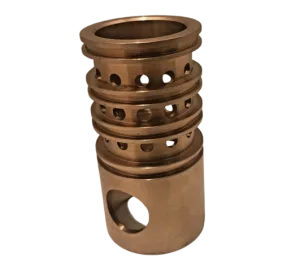
The motor itself is a reciprocating air motor. A dealer listing that quotes Titan describes it as a spool-valve design, and the 940 air motor page lists the valve parts that do the reversing: 743-011 valve rod assembly, 738-213 spring trip and 742-913 brass valve sleeve. The 9 in. motor on a 940 has a 4.0 in. stroke. If you want a part-by-part look at the motor, our air motor parts guide covers the 730, 940, 960 and 975. Taking the motor apart is a job for your model's manual, not for this page.
The fluid section: rod, packings, balls and seats
The fluid section is the part that touches the coating. The rod, which the diagrams call the displacement rod, moves through packings that seal it. Those packings are lubricated from a reservoir; the manual's daily routine is to fill that reservoir half full with Titan Piston Lube 314-480. Coating is moved by two ball valves, one at the bottom of the pump where coating enters from the siphon tube, and one in the piston. Each ball lifts off its seat to let coating pass one way and drops back to stop it returning.
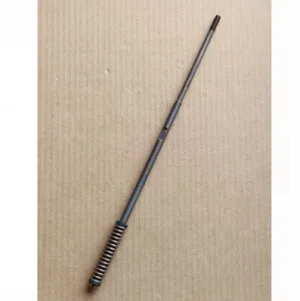
Titan lists self-adjusting packings, a piston rod and cylinder with hard-chrome plating, and tungsten carbide valve seats with hardened steel check balls. A scored rod will destroy new packings, and a worn ball or seat shows up as pulsing, lost pressure or a pump that will not prime. On the 940 fluid pump page the parts to know are the 185-984A displacement rod, 182-921A piston seat assembly, 183-992 foot valve assembly, 178-001A upper packing set and 180-002A lower packing set.
After the pump: filter, bleed valve and hose
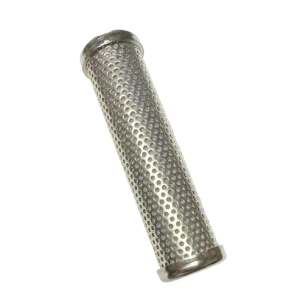
Titan fits a high-capacity outlet filter on every PowrCoat to catch debris before it reaches the hose and gun. On the 730 to 975 models the high-pressure filter page lists the 920-004 filter element, which the site describes as 50 mesh. A partly blocked filter shows up as falling pressure, pulsing and spitting, so it is the quickest and least costly thing to check and clean when the spray pattern changes.
The bleed valve is part of the manual's pressure relief procedure. On the 730 to 975 models the bleed valve page lists the 944-904 tungsten valve seat and the 761-715 tungsten ball as the small parts that seal it. Pressure relief is a procedure you take from your own model's manual, because the steps are written for the machine in front of you.
Which diagram shows which stage
The six stages on the 940 diagrams
| Stage | Diagram page | Parts to look for |
|---|---|---|
| AirCare | Automatic Lubricator Assembly | 0533911 filter, 0533912 auto drain kit, 0533916 lubricator bowl |
| Air motor | Air Motor Assembly | 743-011, 738-213, 742-913 |
| Fluid section | Fluid Pump Assembly (185-551) | 185-984A rod, 178-001A packing set, 183-992 foot valve |
| Outlet filter | High Pressure Filter | 920-004 element |
| Bleed valve | Bleed Valve Assembly | 944-904 seat, 761-715 ball |
| Suction side and muffler | Main Assembly | 0533237A suction set, 830-340 muffler kit |
The 1045, 1064 and 1072 use different page names and some different part numbers. Open the pages for your own model.
Parts from the stages above that appear on the 940 diagrams:
The Short Version
Air goes through AirCare, drives the motor, and the motor strokes the pump; the ratio multiplies the air pressure into fluid pressure; and the fluid leaves through a filter and bleed valve to the hose and gun. When something goes wrong, find the stage first, then open that model's diagram page.
Not sure which stage your problem is in?
Call (713) 931-0006 with your PowrCoat model and what it is doing, and our parts team will point you to the right diagram.
(713) 931-0006Order by Parts Diagram