
Four things set how much paint lands on a surface: the tip's orifice size, its fan width, the pressure setting and your hand speed. A larger orifice delivers more paint, a wider fan spreads it thinner, and pressure should be set just high enough to remove tails. Titan's HEA tips are built to spray at lower pressure, with less overspray.
Four things set the amount of paint on the wall
How much paint ends up on a surface comes down to four controls: the orifice size of the tip, the fan width of the tip, the pressure you set, and how fast you move the gun. Change any one and the film changes. A larger orifice puts out more paint, so you can move faster for the same film. A wider fan spreads the same paint over more area, so each square inch gets less.
The sprayer does not control the coating on its own. Operator technique matters: hold the gun square to the surface, keep a steady distance, and overlap each pass by about half the fan. Pattern problems usually come from tip size, wear, pressure setting, distance or speed.
Tip numbers and flow per orifice
Titan's tips carry a three-digit size. Take a 517: the first digit, multiplied by 2, gives the approximate fan width in inches, so a 5 means about 10 to 12 inches of fan. The last two digits are the orifice in thousandths of an inch, so 17 means 0.017 in. A larger orifice delivers more paint.
Titan's blog gives the flow that goes with a few orifice sizes:
Flow per orifice, from Titan's tip article
| Orifice | Flow |
|---|---|
| 0.017 in. | 0.31 gpm |
| 0.019 in. | 0.40 gpm |
| 0.021 in. | 0.47 gpm |
These match the ControlMax 1700 and 1900 Pro and Impact X 410 delivery figures on Titan's pages. For which orifice suits which coating, see Titan's tip guidance and your coating's data sheet.
The sprayer has to be able to supply the tip. Every Titan model lists a maximum tip size, and putting a bigger tip on a small sprayer causes low pressure. Browse tips on the airless spray tips page.
Setting pressure: tails vs overspray
Titan's guidance on pressure is simple. Too little pressure leaves tails, which are heavy lines at the edges of the fan. Too much pressure causes overspray, waste and cleanup. Turn the pressure up until the tails disappear, then stop. If the pump stops pressurizing consistently, Titan says to check the packings. If it reaches one side of its stroke and then returns rapidly, check the ball and seat.
If the sprayer is already at maximum pressure and the pattern is still weak, Titan advises using a larger-diameter hose or a shorter hose. Friction in a long, narrow hose costs pressure at the tip.
HEA: lower pressure, softer spray
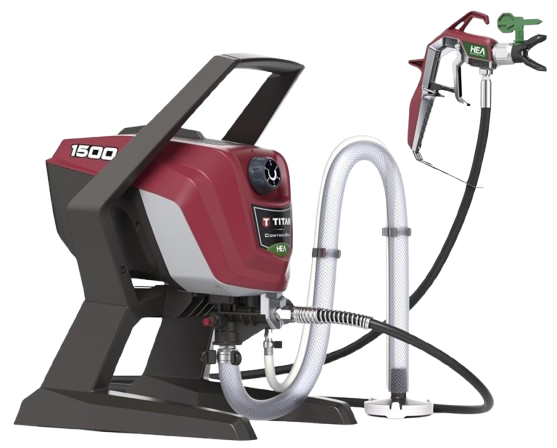
High Efficiency Airless, or HEA, is Titan's lower-pressure system. Titan describes its HEA tips as optimized to spray all architectural paints and coatings at 1000 psi, with overspray up to 55 percent lower. The ControlMax line is built around it, and Titan describes the coating as sprayed unthinned. Lower pressure is the idea behind the reduced overspray.
ControlMax HEA sprayers (Titan and ControlMax pages)
| Model | Max delivery | Max pressure | Max tip | Tip chart limit |
|---|---|---|---|---|
| ControlMax 1500 | 0.29 gpm | 1500 psi | 0.015 in. | Up to 515; 517 and 619 not compatible |
| ControlMax 1700 | 0.33 gpm | 1500 psi | 0.017 in. | Up to 517; 619 not compatible |
| ControlMax 1900 Pro | 0.40 gpm | 1600 psi | 0.019 in. | Up to 619 |
HEA tips are limited by the sprayer's maximum tip size, so check the tip chart before ordering. Parts are on the ControlMax HEA sprayer parts page.
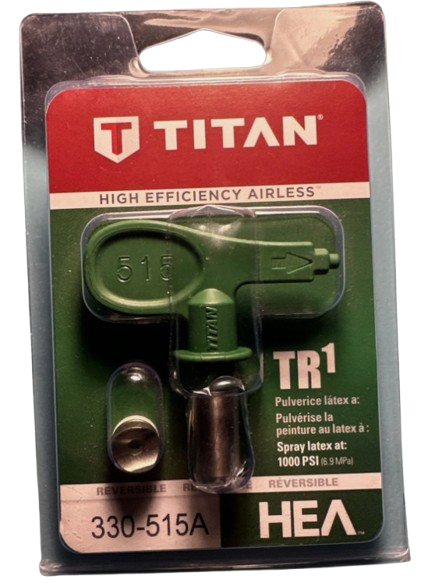
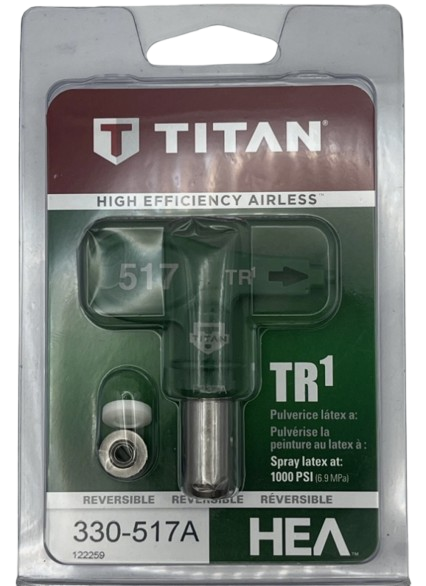
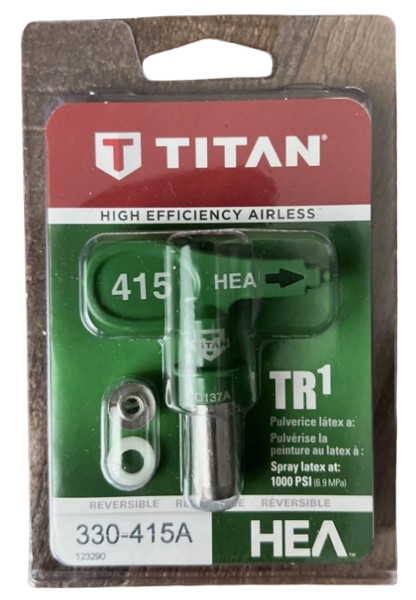
Titan's TR1 HEA tips on this site include the 330-415A (415), 330-515A (515) and 330-517A (517). Reversible tips like these turn 180 degrees to clear a clog.
Pressure control built into the sprayer
Some Titan sprayers take part of the pressure job off your hands. The Impact X 410, X 440 and X 540I list Logix Adaptive Pressure Control, which Titan describes as sensing the tip, minimizing pressure while maximizing efficiency. Titan's Impact range lists Electronic Pressure Control with Rapid Clean. On the air-assisted MultiFinish 440, Titan lists an air pressure of 30 psi alongside the 3300 psi fluid pressure. These systems help, but they sit on top of the same four levers.
Worn tips and loose control
A tip's orifice enlarges with use. As it does, flow rises and the fan narrows, and the paint goes on heavier in a narrower band. Titan says to replace a worn tip, which also cuts excess overspray and waste. Titan also advises buying a sprayer 10 to 20 percent more powerful than the tip you plan to use, so a tip that has worn does not exceed what the sprayer can supply.
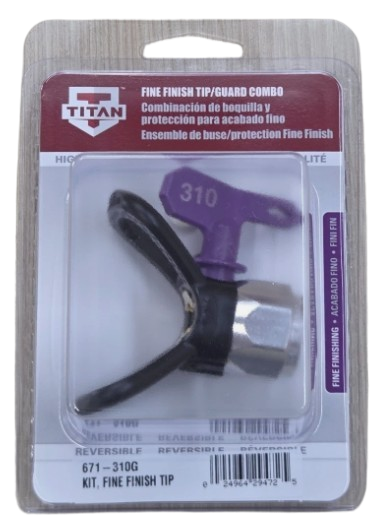
For fine finishes, the 671-310 SC-6+ tip is on the site. Browse more on the spray guns and tips page.
HEA tips, a fine-finish tip and the ControlMax sprayers they pair with:
The Short Version
Pick the orifice for the coating, set the fan for the surface, raise pressure only until tails clear, and keep your pace steady. Replace tips when the pattern degrades, and confirm any HEA tip against your sprayer's limit.
Not sure which tip your sprayer can use?
Call (713) 931-0006 with the model and serial number and our parts team will confirm the tip before you order.
(713) 931-0006Order by Parts Diagram