
An airless sprayer uses a pump to push paint to very high fluid pressure. The paint travels through a hose to a gun and is forced through a tiny opening in the tip. That sudden squeeze breaks it into fine droplets in a fan shape. No air is used to atomize the paint, which is why it is called airless. Wagner puts the pressure at 1200 to 3300 psi or higher.
What airless means
Most people picture a sprayer blowing paint out with a stream of air. An airless sprayer does not. The coating itself is forced through a small tip at very high fluid pressure, and the pressure alone breaks it into droplets. Wagner gives the range as 1200 to 3300 psi or higher, and that is the number to keep in mind: it is why airless is fast on big surfaces and also why it is handled with respect.
HVLP is the contrast. It uses a high volume of low-pressure turbine air to atomize the coating, which gives a finer finish with less bounce-back, according to Wagner, but covers area more slowly. Airless covers large areas faster and throws more overspray. If you are choosing between technologies, the Titan paint sprayers page is the place to start browsing models.
The pump builds the pressure
The heart of the machine is a piston pump. A drive moves the piston rod, and the rod slides through packings that seal it so pressure can build instead of leaking out. Inlet and outlet valves, each a seat and a ball, open and close on alternate strokes: one lets paint in, the other lets it out under pressure.
What turns the pump varies by sprayer. Electric units suit sites with power, gas units give portability where there is none, and hydraulic-drive sprayers such as the Hydra series are built for high-volume, heavy and protective coatings. The pump principle is the same in all of them.
As a real example, the Titan Impact X 440 is rated at 3300 psi maximum and 0.54 gpm. That is the sprayer's ceiling, not the pressure you spray at. You can see it listed as 2430510.
Hose, gun and tip
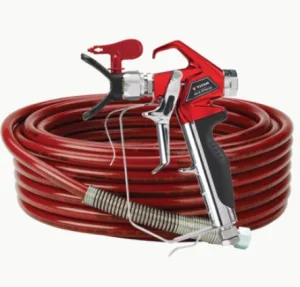
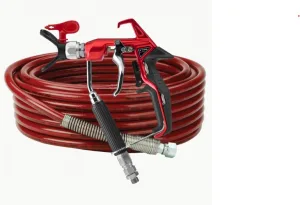
Pressurized paint travels along a hose to the gun. The hose must be airless-rated, conductive or grounded, and rated at or above the sprayer's maximum pressure; no component in the line may be rated lower than the sprayer's working pressure. The gun holds the trigger and a trigger lock, and carries the tip behind a tip guard, which keeps a hand from reaching the high-pressure stream.
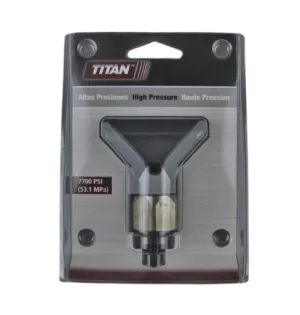
The tip does the atomizing. Its orifice controls how much paint is delivered, and a thicker coating generally needs a larger orifice. Its fan angle sets the width of the pattern. The tip is a small part doing a hard job: the paint is moving through it at speed, which wears it. A worn tip has a wider orifice, so pressure falls, the pattern turns coarse or streaky and more paint is used.
Reading a tip number
Tip numbers follow a simple rule, confirmed by Titan, Behr and the RX-Apex manual. The first digit times two is the approximate fan width in inches, measured at 12 in. from the surface. The last two digits are the orifice size in thousandths of an inch.
Two worked examples
| Tip | Fan width | Orifice |
|---|---|---|
| 517 | About 10 in. | 0.017 in. |
| 515 | About 10 in. | 0.015 in. |
Same orifice with a wider fan gives a thinner coat, according to Titan. Browse tips on the airless spray tips page, for example the 695-517G tip and guard kit.
Why pressure is adjustable
The sprayer's maximum is not the setting to use. The Impact 440 manual and Titan both say to use the lowest pressure that atomizes the coating completely: start at minimum, raise the pressure control slowly and test on cardboard until the pattern shows no heavy edges, called tails. Lower pressure reduces overspray, tip wear and strain on the pump.
Titan's High Efficiency Airless (HEA) tips take this further. They are designed to atomize at about 1000 psi or lower, against about 2000 psi for conventional airless, and Titan says that gives up to 55% less overspray and longer pump life. The 0538077 HEA kit is one example from the catalog.
What this means for parts
Knowing the path tells you where things fail. A pump that will not hold pressure or leaks at the wet cup points at packings; the site's repacking kits page holds them. A pump that pulses or will not prime points at inlet or outlet valve seats and balls. A poor pattern points first at the tip, then at partly blocked filters, which cause pressure loss, pulsing and spitting. Filters are on the Titan filters page, and guns, tips and accessories are on the spray guns and tips page.
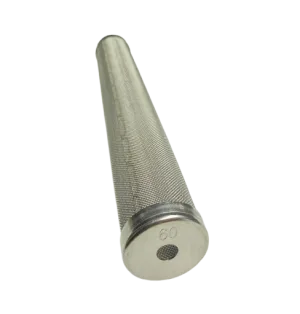
Start with the tip and the filters before opening the pump, because they are the quickest checks. Two catalog examples are the tip guard 661-027 and the 60 mesh manifold filter 730-067.
Parts that map to the stages above:

 −16%
−16%
The Short Version
A pump builds fluid pressure, a hose carries it and a small tip turns it into a fan with no air. Use the lowest pressure that atomizes the coating, and check tip and filters before suspecting the pump.
Need the right tip or pump part?
Call (713) 931-0006 with your sprayer model and serial number and our parts team will confirm the part.
(713) 931-0006Order by Parts Diagram