Airless pumps coating through a small tip at high pressure and is fastest on large flat surfaces. HVLP atomizes with a high volume of low-pressure air, giving finer control for trim, doors and cabinets. Air-assisted airless adds compressed air at the tip for a finer finish than plain airless. Titan makes sprayers in each type, plus texture and handheld models.
The three spray technologies in one table
All three types do the same job, which is to break liquid coating into a fine mist and put it on a surface. They differ in how. That choice decides speed, finish quality, overspray and how much equipment you carry. The descriptions below follow Titan's own explanations; check your coating's data sheet and your sprayer's manual for specifics.
Three ways to atomize paint
| Type | How it works | Titan's shorthand | Best on |
|---|---|---|---|
| Airless | A pump forces coating through a small tip orifice at high fluid pressure. No compressor. | A substitute for the roller | Large flat areas: walls, ceilings, exteriors |
| HVLP | A turbine or compressor supplies a high volume of air at low pressure to atomize coating from a small cup on the gun. | A substitute for the brush | Trim, doors, windows, furniture, cabinets |
| Air-assisted airless | An airless pump plus compressed air that finishes atomizing at the tip. | No Titan shorthand | Fine finishes where airless speed still matters |
Roller and brush shorthand is Titan's wording from its buying articles.
Airless: speed on large, flat surfaces
An airless sprayer needs no air compressor. A pump pressurizes the coating and the tip orifice breaks it into a fan. Titan says airless sprays essentially all coatings and works best on large flat areas such as walls, ceilings, exteriors and barns. It also says sprayers get jobs done 3 to 4 times faster than traditional rollers, and up to 10 times on high-production commercial jobs. Those are Titan's figures, and your result will depend on the job.
The trade-off is overspray. Titan's example compares about 2,000 psi at an airless tip with about 10 psi on an HVLP gun. Higher fluid pressure puts more mist in the air.
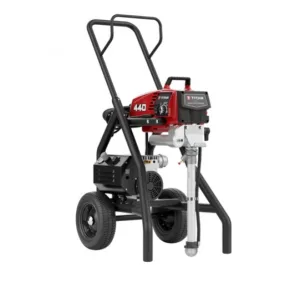
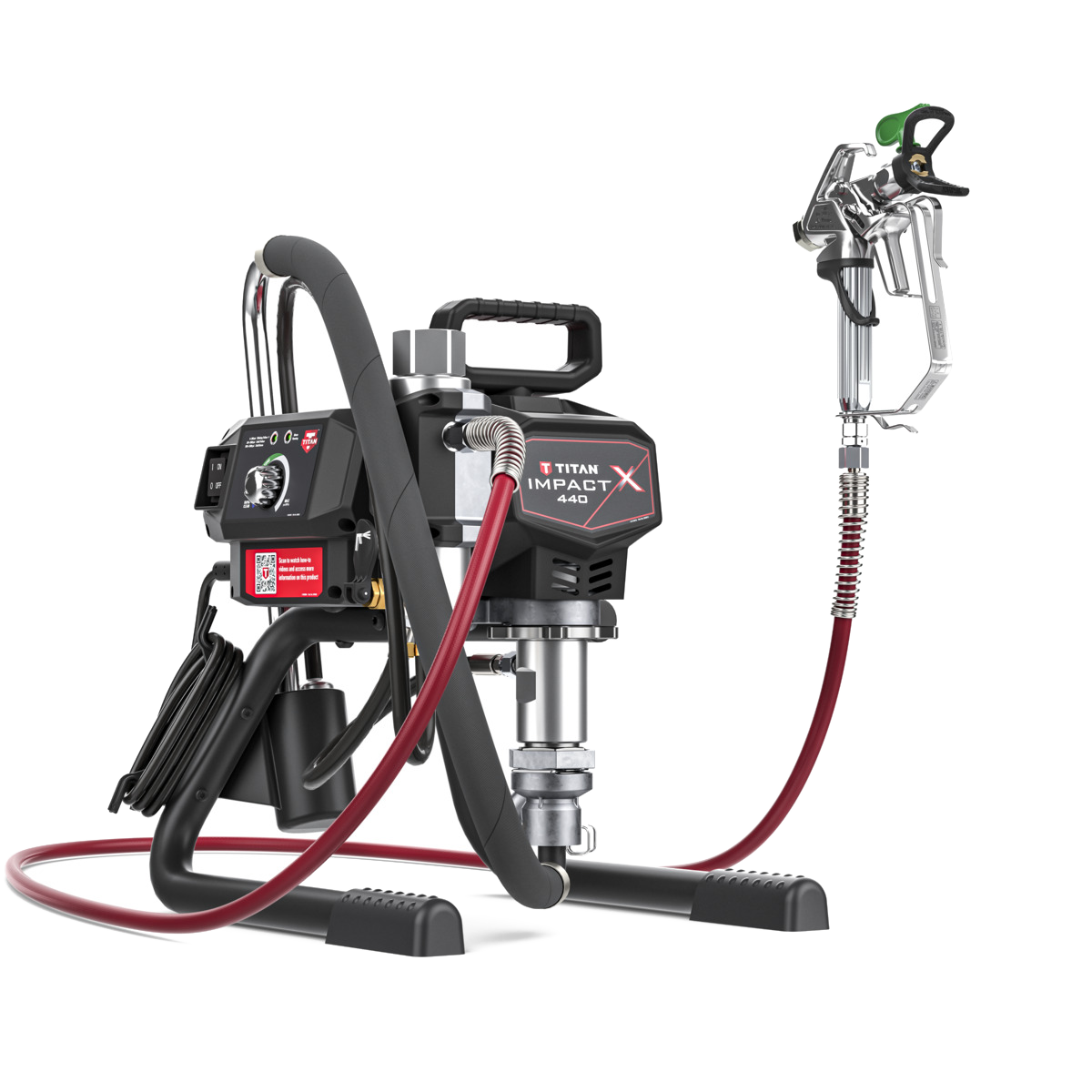
Titan's airless lines cover a wide range. Impact is piston-driven electric, Elite is sealed hydraulic, PowrTwin and PowrBeast are hydraulic, Hydra X is gas hydraulic, and PowrCoat is pneumatic, driven by shop air. The entry model most buyers meet first is the Impact X 440; the gas hydraulic line begins with models like the PowrTwin 4900 Plus. Browse them by diagram in the electric, gas and air-powered sections.
HVLP: control for trim, doors and cabinets
HVLP stands for high-volume, low-pressure. A turbine or compressor atomizes the coating with air at up to about 10 psi, from a small cup on the gun, and Titan quotes a transfer efficiency of 70 to 90 percent. Less overspray means less masking and cleanup, and the gun is held about 6 inches from the surface, against about 12 for airless.
The cost is speed. Titan says HVLP production is slower than airless, many materials need thinning with the small nozzles, and it is not a replacement for airless on large flat surfaces. Cleaning is the gun and cup rather than a pump and hose.
Titan's Capspray X line is the HVLP turbine range. The stage count is the number of turbine stages: Capspray X 95 is 4-stage, X 105 is 5-stage and Capspray X 115 is 6-stage. Titan's stage guidance is that 2 to 3 stages suit stains, lacquers and enamels, 4 to 5 stages add epoxies, oil-based house paints and heavy stains, and 5 to 6 stages add finish-quality latex. Parts are on the fine finishing sprayer parts page.
Air-assisted airless and fine-finish airless tips
Air-assisted airless combines an airless pump with a compressor that adds air at the end of atomization. Titan says this lets you reduce overall line pressure by a significant amount, and gives its example of about 1200 to 1300 psi with a hybrid enamel. Titan's MultiFinish 440 has an onboard compressor, delivers 0.58 gpm at 3300 psi and takes a 0.023 in. maximum tip, with air at 30 psi. Per Titan, you can switch the compressor off and spray as standard airless. Keep the air-port guard on the tip end clean. See the MultiFinish 440.
A middle path is a fine-finish tip on a regular electric airless sprayer. Titan says a modern electric airless with its SC-6+ Synergy fine-finish tip and tip-sensing control can produce fine finishes at higher speed than HVLP or air-assisted systems. It also says this may slow production a bit, and it does not suit many medium to high viscosity coatings.
Other sprayer types you may need
- Texture and aggregate. Titan's PowrMax 605 is a rotor-stator sprayer at 5 gpm and 580 psi, takes aggregate up to 6 mm, and sprays water-based materials only; it needs a 12 cfm compressor. See the texture sprayer parts.
- Handheld and cordless. The Impact X 120 18V, FlexSpray Pro 18V and ControlMax 1650 18V are Titan's battery models for small jobs. The Impact X 120 back pack sprayer is on this site.
Match type to job, then find your parts
- Painting walls, ceilings or an exterior: airless.
- Spraying cabinets, doors, furniture or trim, where finish quality matters more than speed: HVLP or air-assisted airless.
- Needing fine finish and decent speed on a mix of work: air-assisted airless, or airless with a fine-finish tip.
- Spraying drywall texture or aggregate: texture equipment designed for it.
Whichever you buy, follow the coating maker's data sheet and the sprayer's manual. Once you own a model, find the part you need through its diagram, and call (713) 931-0006 with the model and serial number if fitment is unclear.
Sprayers on this site from each type:

The Short Version
Airless for big flat surfaces and speed, HVLP for control on small pieces, air-assisted airless when you want a finer finish without giving up airless delivery. Decide the finish first, then the type, and only then the model.
Not sure which sprayer type fits your work?
Call (713) 931-0006 and our parts team will point you to the right diagram once you know the model.
(713) 931-0006Order by Parts Diagram