
Titan's CapSpray manuals say to plug into a grounded 3-slot receptacle, use a heavy extension cord (12 gauge recommended, no longer than 100 ft, outdoor cords marked W-A), and put the turbine as far from the spray area as possible. A tripped breaker stops the turbine; reset it once and have a repeat trip inspected.
A CapSpray is an electric turbine, so a weak power supply shows up as lost power, an overheating cord or a machine that will not start, and it is easy to blame the turbine for what the cord is doing. This guide covers what Titan's owner's manuals say about outlets, extension cords and turbine placement, and which breaker, switch and cord parts are on our diagrams. The cord details come from published extracts of the manuals for the CapSpray 95, 105 and 115, so check your own manual before you rely on them. None of this is electrical-code advice.
Plug into the right outlet
Titan's manuals call for a grounded 3-slot receptacle. Do not defeat the ground with an adapter. If the only outlet on site is ungrounded, that needs sorting out first, not working around.
The turbine assemblies and the warning light on our diagrams carry a 120V label, for example the 0524547 warning light assembly 120v on the upper housing pages. Titan also lists a CapSpray 105, 230V, under part number 276047. It is not one of the parts on our site, so if you own that version, call (713) 931-0006 before ordering any electrical part, because we cannot confirm which parts it shares with the 120V unit.
We do not give an amperage here. The figures published for the different CapSprays disagree between sources, so do not size a circuit from a web page, including this one. Your manual and the label on the unit show the current draw, and an electrician can size the circuit from that.
Extension cord rules
On a job the outlet is rarely next to the work, so the extension cord matters. The manuals' guidance is short:
Extension cord guidance from Titan's CapSpray manuals
| Point | What the manual says |
|---|---|
| Gauge | Use a heavy-duty cord. 12 gauge is the recommended size. |
| Length | No more than 100 ft. |
| Outdoor use | Use a cord marked W-A for outdoor work. |
| Why it matters | An undersized cord loses power and overheats. |
From published extracts of the 95, 105 and 115 manuals. Confirm against the manual that came with your unit.
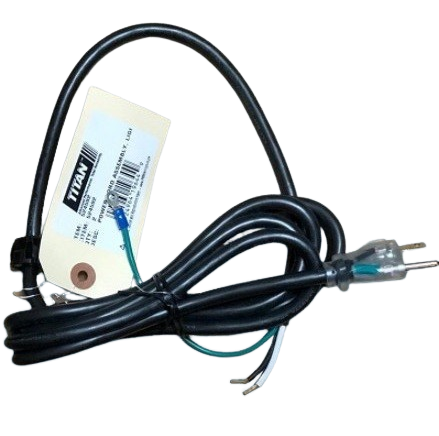
Read the 100 ft as a ceiling, not a target: a shorter cord of the right gauge loses less than a long one, so use the shortest that reaches. If the extension cord is sound and the cord on the machine itself is damaged, that one is a replaceable part, listed below.
Where to put the turbine
The manuals say to keep the turbine as far from the spray area as possible, because it has parts that can spark. That fits how the system is built: the turbine only makes air, and the hose carries the air to the gun, so the machine does not need to sit next to the work. Titan ships the CapSpray 95, 105 and 115 with a 30 ft air hose, and the 105 and 115 add a 5 ft whip hose. Use the hose that came with the unit rather than guessing at a longer one. Titan's text also says never to connect the short whip hose directly to the turbine, because it will be damaged.
Put the unit where the cord can reach the outlet without pulling tight, and where nobody will step on it or roll a ladder across it. The 0090628 foot pad is on the lower housing page of every classic and X model if one has gone missing.
The circuit breaker
When the turbine will not run, Titan's manuals list no power, a tripped circuit breaker and worn motor brushes as the causes to check. For a tripped breaker, the manual says to reset it, and if it keeps tripping to have the unit inspected. A breaker that trips again after a reset is telling you something is wrong. Resetting it repeatedly hides that.
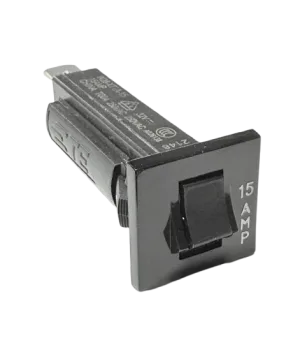
The CapSpray has its own breaker. Our 0524549 circuit breaker switch kit, 15A, is listed on the Upper Housing page for the CapSpray 75, 95, 105 and 115 and the X 95, 105 and 115. The manual extract does not say whether it means the breaker on the unit or the one at the panel, so check both. Check the outlet and the cord first, since those cost nothing, and look at what else is running on the same circuit.
Power cord and switch parts
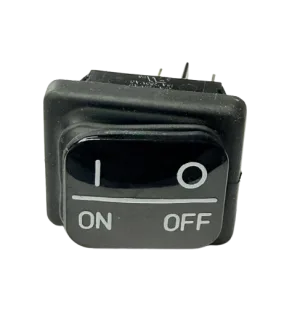
These are the electrical parts on the CapSpray diagrams. The numbers are shared across several models, but open the page for your exact model before you add one:
CapSpray power-side parts
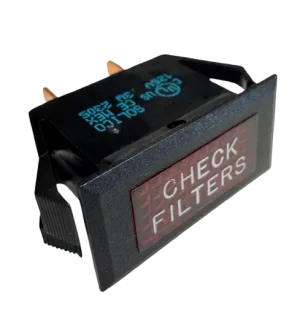
Find your page from the model name: CapSpray 95 Upper Housing and Lower Housing, or the CapSpray 115 Upper Housing. The 75, 105 and X models have the same four-page layout under their own names. If the warning light is the symptom, check the filters before any switch.
A setup order that avoids the usual problems
Pick the outlet first
Find a grounded 3-slot outlet close to where the turbine can sit away from the spray area.
Choose the shortest suitable cord
If you need one, use a heavy cord at the gauge and length your manual gives, marked W-A for outdoor use.
Set the turbine down
Away from the spray area, on a level surface, with the cord out of the walkway.
Connect the air hose
Long hose from the turbine outlet to the gun. The short whip, if your model has one, goes at the gun end, never directly on the turbine.
Plug in last
Then switch on. If a breaker trips, reset it once and have a repeat trip inspected.
Power-side parts from the CapSpray housing diagrams:

The Short Version
Grounded 3-slot outlet, the shortest heavy cord that reaches (12 gauge recommended, no more than 100 ft, W-A outdoors), the turbine well away from the spray area, and a breaker you reset once and then investigate. The cord, breaker kit, switch and ground screw are all on the CapSpray housing diagrams.
Not sure which cord or switch part is yours?
Call (713) 931-0006 with your CapSpray model and serial number and our parts team will confirm the part before you order.
(713) 931-0006Order by Parts Diagram