
HEA stands for High Efficiency Airless. Titan describes the TR1 HEA tip as optimized to spray all architectural paints and coatings at 1,000 psi at production speed, and says it decreases overspray by up to 55%. Those are Titan's statements. Your sprayer's manual, not the tip, sets the pressure you run.
What HEA means
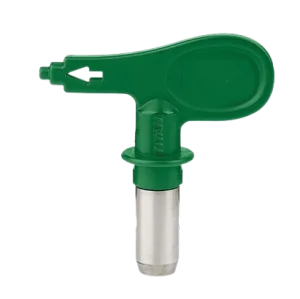
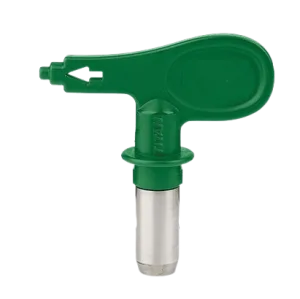
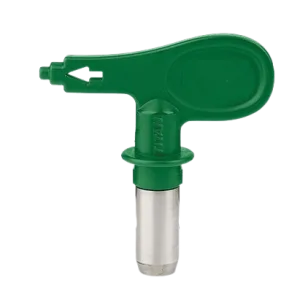
HEA stands for High Efficiency Airless. It is the name Titan gives to a family of TR1 spray tips designed to atomize coating at a lower fluid pressure than a conventional airless tip. On our site they are the 330-series tips, listed on the TR1 HEA Tips page.
Titan quotes the HEA tip at a working pressure of 1,000 psi, which is a design target for the tip rather than a limit or a setting.
What Titan claims
These are Titan's own statements about the tip, repeated here as claims, not as results we measured:
- The tip is optimized to spray all architectural paints and coatings at 1,000 psi at production speed.
- It decreases overspray by up to 55%.
- Titan also says lower-pressure spraying decreases overspray and extends the life of the pump.
Read the wording closely. Up to 55% is a ceiling Titan quotes, not what you will see on every job, and the 1,000 psi figure describes the pressure the tip is optimized for, not a setting every sprayer can hold. Titan does not publish a replacement interval or a tip life in hours or gallons, so there is no figure to plan around.
What that means at the sprayer
The tip does not change the pressure by itself. You set the pressure at the sprayer, and the right way to do that is in your model's manual. Do not assume a particular sprayer runs well at 1,000 psi. Some models are built for much higher working pressures, and how low a given unit can be set and held steady is a question for the manual or for our parts team.
Titan ties its two benefits to the lower pressure: less overspray, and a pump that is not asked to build as much pressure. Those are Titan's statements, and the manual is where you find out what your own sprayer can do.
A worn HEA tip is still a worn tip
HEA does not remove wear. Like any airless tip, the orifice widens as it wears, the pressure at the tip falls, the pattern turns coarse or streaky and you use more paint to cover the same wall. When a pattern that used to be clean stays rough after you have cleaned the tip and filters, treat the tip as the suspect and replace it.
Because an HEA tip is designed to run at low pressure, a pressure drop is easy to blame on the wrong thing. Check the filters and the tip first, since both are cheap, before you look at the pump.
Where you can buy HEA tips and kits
The TR1 HEA Tips page lists 16 tips, for example 330-517A, 330-515A and 330-415A. The size range is covered in our guide to TR1 HEA tip sizes, so this article does not repeat it.
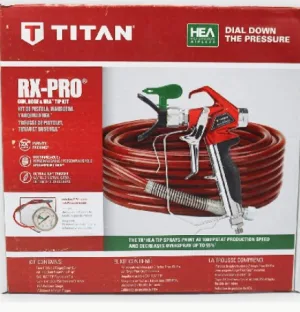
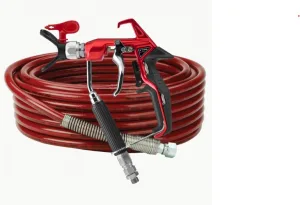
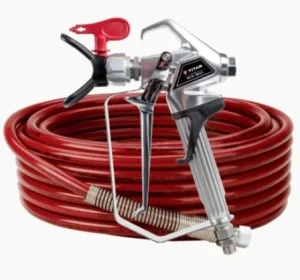
Three Titan gun kits come with an HEA 517 tip. On the site they are listed as 0538033 RX-Pro Airless Spray Gun, 2454979 RX-80 Airless Spray Gun and 0538077 RX-APEX Gun Hose and TR1 HEA Tip Kit. Other kits are on the gun, hose and tip kits page.
HEA tips and the kits that include one:
What not to assume
- No maximum pressure is given here. Titan's own HEA pages print a pressure rating that conflicts with itself, so check the rating marked on your tip against the lowest rating in your system: gun, hose, fittings and tip guard.
- Dealer claims of paint savings or a tip life several times longer are not Titan's published numbers. Do not buy on them.
- Your tip guard and handling stay the same. Keep a guard on the gun, and clear a clog only the way your tip's instructions describe.
If you are matching a guard to a tip, see the tip guards page. Browse every tip family from Airless Spray Tips, and keep your model's manual on hand from Manuals.
The Short Version
An HEA tip is Titan's low-pressure airless tip. Titan says it is optimized for architectural coatings at 1,000 psi and cuts overspray by up to 55%. Those are manufacturer statements, so set your pressure from the sprayer manual, keep the guard on, and replace the tip when the pattern degrades.
Not sure an HEA tip suits your sprayer?
Have your sprayer model and serial number ready and call (713) 931-0006, and our parts team will confirm fitment.
(713) 931-0006Order by Parts Diagram